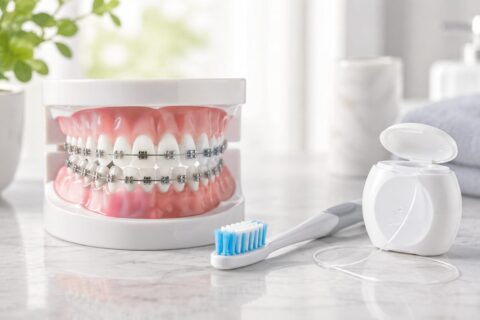
Can you get braces with dental implants, crowns, or fillings? Usually yes — past dental work rarely rules out orthodontic treatment. The key difference is that a dental implant does not move like a natural tooth, so your orthodontist plans around it, while crowns, fillings, and veneers move along with your teeth.
Many adults who want to straighten their teeth already have restorations from years of dental care, and they are often relieved to learn it is not a barrier. Here is how orthodontics works alongside crowns, implants, and other prior dental work, whether you are considering braces or aligners.
Why Dental Implants Are Different
The most important thing to understand is how a dental implant behaves. Unlike a natural tooth, which sits in the jaw in a way that lets it be moved, an implant is fused directly to the bone. That makes it extremely stable — but it also means an implant cannot be moved orthodontically the way a natural tooth can.
This does not prevent braces; it simply shapes the plan. Your orthodontist treats the implant as a fixed anchor and moves the natural teeth around it. If you are considering an implant but have not placed it yet, the timing matters — sometimes it is best to straighten first and place the implant afterward, which is a conversation to have before either begins.
Braces With Crowns and Bridges
Crowns and bridges are common, and they generally work well with orthodontic treatment. A crown covers a natural tooth, and because the tooth underneath is still a natural tooth, it can be moved with braces or aligners like any other — the brackets simply bond to the crown surface, which your orthodontist accounts for.
Bridges are a little different because they connect multiple teeth and cannot flex, so they need specific planning; in some cases a bridge is temporarily modified or replaced as part of the overall plan. None of this is unusual, and an experienced orthodontist coordinates it smoothly. Our guide to the best braces for adults covers more of what adult treatment involves.
Braces With Fillings and Veneers
Fillings are the most straightforward of all — they are part of the natural tooth structure and move right along with the tooth, so they require no special handling during orthodontic treatment. If you have fillings, they simply come along for the journey.
Veneers take a bit more care. Like crowns, they cover natural teeth that can still be moved, but the bonding surface is different, so your orthodontist uses techniques suited to veneers when attaching brackets, or may favor clear aligners. If you are planning new veneers, straightening first often produces a better cosmetic result, since the veneers can then be designed for properly aligned teeth.
Planning Treatment Around Restorations
The theme running through all of this is planning. Before treatment begins, your orthodontist reviews your full dental history and current restorations, identifies what can move and what cannot, and builds a plan that respects your existing work while still delivering the result you want.
Sometimes the sequence of care matters — for example, completing orthodontics before placing a final implant or new veneers so everything fits the corrected bite. This is a normal part of adult treatment planning, and it is one reason a thorough consultation matters. The American Association of Orthodontists recommends a specialist evaluation to coordinate exactly this kind of case.
Clear Aligners and Dental Work
For patients with restorations, clear aligners can be an especially convenient option. Because aligners fit over the teeth rather than bonding brackets to each surface, they sidestep some of the bonding considerations that crowns and veneers raise, and they work around an implant just as braces do.
That said, the best choice still depends on your specific case and goals, not just your dental history. Some situations favor the complete control of fixed braces. Your orthodontist weighs everything together and recommends the approach that fits both your restorations and the result you are after.
The Team Approach With Your Dentist
Orthodontic treatment with existing dental work is a team effort. Your orthodontist and your general dentist coordinate so that your restorations are protected and any needed dental work is sequenced correctly with your orthodontic plan. Good communication between them is what keeps everything on track.
Keeping your teeth and gums healthy throughout treatment is essential too, especially with restorations in place; the American Dental Association has helpful guidance on maintaining oral health during orthodontic care. With the right team and plan, previous dental work is simply part of the picture, not an obstacle.
Timing: When to Straighten Around Dental Work
For adults especially, the order of care can matter as much as the care itself. When you are planning both orthodontics and new restorative work, straightening first often produces a better final result, because your dentist can then design crowns, veneers, or a bridge to fit properly aligned teeth and a corrected bite. Getting braces with dental implants already in place is very doable, but if an implant has not been placed yet, it is usually best to complete tooth movement first and position the implant into the finished result.
This is because an implant is fixed once it fuses to the bone, so placing it before straightening can lock in a position that does not fit your final smile. Your orthodontist and dentist map out the sequence together at the planning stage, so nothing is done out of order. Our guide on whether it is ever too late for braces is a helpful companion if you are weighing adult treatment, and our overview of the best braces for adults covers appliance choices that suit patients with restorations.
The takeaway is that getting braces with dental implants and other dental work is rarely a question of “if” and much more a question of “in what order.” With a coordinated plan, your existing work is protected and your new smile is built to last. If you have restorations and have been unsure whether orthodontics is realistic, this timing conversation is exactly what a consultation sorts out.
The Bottom Line on Braces With Existing Dental Work
Previous dental work rarely stands in the way of a straighter smile. Implants act as fixed anchors that your orthodontist plans around, while crowns, bridges, fillings, and veneers generally move with your teeth or are handled with straightforward techniques. Careful planning and coordination with your dentist make it all work.
If you have held off on orthodontics because of past dental work, it is worth finding out what is possible. A consultation reviews your restorations and shows you exactly how treatment can be tailored to your smile.
If there is one message to take from all of this, it is that you should not let past dental work talk you out of a consultation. Many adults assume their crowns, bridges, implants, or old fillings make them poor candidates, and they are pleasantly surprised to learn how routinely orthodontists work around exactly these situations. The complexity is real, but it is complexity your orthodontist manages every day, in partnership with your dentist. What matters is that everything is planned together from the start, so your restorations are protected and your treatment is sequenced correctly. Rather than guessing whether your dental history rules you out, the most useful thing you can do is bring it to an evaluation, where it can be reviewed in detail and turned into a clear, realistic plan for the smile you want. Bringing along recent dental records or the name of your dentist helps too, since it lets your orthodontist coordinate care from the very first conversation. The more complete the picture at the start, the smoother the plan tends to be, and the fewer surprises arise along the way.
Frequently Asked Questions
Can you get braces if you have dental implants?
Yes, in most cases. A dental implant is fused to the bone and cannot be moved like a natural tooth, so your orthodontist treats it as a fixed anchor and moves the natural teeth around it. If an implant is planned but not yet placed, the timing is coordinated with your orthodontic treatment.
Can you have braces with crowns or a bridge?
Yes. A crown covers a natural tooth that can still be moved, and brackets bond to the crown surface. Bridges connect multiple teeth and need specific planning, and are sometimes modified or replaced as part of the overall plan. An experienced orthodontist coordinates this smoothly.
Do fillings affect orthodontic treatment?
No. Fillings are part of the natural tooth structure and move along with the tooth, so they require no special handling during braces or aligner treatment.
Should I straighten my teeth before getting veneers or an implant?
Often, yes. Completing orthodontics first means new veneers or an implant can be designed and placed for properly aligned teeth, which usually produces a better result. Your orthodontist and dentist coordinate the best sequence for your case.
Are clear aligners a good option with existing dental work?
They can be. Aligners fit over the teeth rather than bonding to each surface, which sidesteps some considerations that crowns and veneers raise, and they work around implants like braces do. The best choice still depends on your case and goals.
Have crowns, implants, or other dental work and want straighter teeth? Schedule a complimentary consultation with Dr. Orbach at our Washington, DC or Alexandria, VA office, and get a plan tailored to your smile that works with the dental work you already have, carefully coordinated with your dentist every step of the way.
For more guidance on this topic, read our related guide: Gum Health and Adult Orthodontics: Braces and Gum Recession.