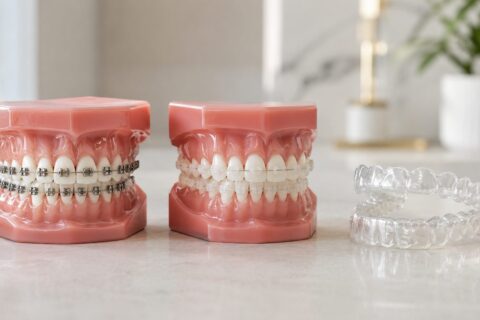
Do you need a tooth extraction for braces? Usually not. Most cases today are treated without removing any teeth. Extractions are reserved for severe crowding or significant protrusion, where removing a tooth creates the space needed for a healthy, stable result. Your orthodontist decides only when it truly helps.
The idea of having a tooth pulled understandably makes people nervous, so it helps to know the facts. Here is when a tooth extraction for braces is and is not needed, the alternatives available today, and how the decision is reached.
Why Extractions Are Sometimes Needed
Extractions come down to space. When there is simply not enough room in the jaw for all the teeth to fit in proper alignment, something has to give. In cases of severe crowding, removing one or more teeth — often premolars — creates the space needed to straighten the remaining teeth and achieve a stable bite.
The other common reason is significant protrusion, where the front teeth stick out too far. Removing teeth can allow the front teeth to be brought back into a healthier, more balanced position. In both situations, the goal is the same: a result that looks good, functions well, and lasts. Crowding is the most frequent driver, and our article on how braces address spacing issues covers the opposite problem.
How Common Are Extractions Today?
Far less common than they used to be. Advances in orthodontic techniques and appliances mean that many cases once treated with extractions can now be handled without them. Orthodontists today generally aim to preserve teeth whenever it is possible to achieve an excellent, stable result that way.
That said, extractions have not disappeared, because for some cases they genuinely produce the best outcome. The right approach is neither to extract by default nor to avoid it at all costs, but to choose based on what your specific case needs. This is exactly the kind of judgment a specialist evaluation provides.
Alternatives to Extraction
When space is tight but extraction is not clearly necessary, orthodontists have several tools to create room without removing teeth. Arch expansion can widen the dental arch to make more space, which is especially effective in growing patients. Interproximal reduction — gently reshaping a tiny amount of enamel between teeth — can free up small amounts of space in milder cases.
Modern braces and clear aligners can also move teeth in ways that make the most of the available space. These alternatives mean that today, extraction is one option among several rather than an automatic step. Your orthodontist weighs them all, and our overview of the types of braces shows the appliances involved.
What a Tooth Extraction for Braces Involves
If an extraction is recommended, it is a routine, well-tolerated procedure. The teeth removed are usually premolars, chosen because taking them creates useful space with minimal impact on your smile and function. The extraction itself is typically done by your dentist or an oral surgeon before braces are placed or early in treatment.
The procedure is done with local anesthesia and recovery is usually quick and straightforward. Because premolars sit further back, the spaces created are closed during orthodontic treatment and are not visible in your finished smile. Your orthodontist coordinates the timing so everything fits your overall plan.
Does an Extraction Affect Your Results or Timeline?
A common worry is that extractions will hollow the face or harm the smile, but when extractions are planned properly by a specialist, the result is a healthy, full, and stable smile — that is the entire point of choosing them only when they help. Modern treatment planning aims for balanced, natural-looking results.
As for timing, closing extraction spaces is part of the treatment plan and factored into your estimated timeline from the start. Our guide to how long treatment takes explains what shapes the schedule. The American Association of Orthodontists emphasizes specialist planning precisely so that outcomes stay healthy and predictable.
How the Decision Is Made
Whether you need an extraction is never a guess — it comes from a careful evaluation. Your orthodontist examines your teeth, takes digital records and images, and analyzes how much space you have versus how much your teeth need. Only then is an extraction considered, and only when it clearly leads to a better, more stable result than the alternatives.
You are part of that conversation. Your orthodontist explains why an extraction is or is not recommended and what the alternatives would mean for your case, so you can make an informed decision. Keeping your teeth and gums healthy supports any plan; the American Dental Association offers guidance on care throughout treatment.
Common Worries About Tooth Extraction for Braces
A lot of anxiety around a tooth extraction for braces comes from older ideas about orthodontics, so it is worth addressing the common worries directly. The first is that extractions “sink” the face or flatten the profile. In careful, modern treatment planning this does not happen — spaces are managed so the result is a full, balanced smile, which is precisely why extractions are only chosen when they clearly produce the best outcome.
A second worry is that removing healthy teeth is wasteful or harmful. When an extraction is genuinely indicated, it is because there is not enough room for all the teeth to be healthy and well-aligned, and a crowded, overlapping bite carries its own long-term risks for cavities and gum problems. In those cases, creating space leads to a healthier mouth overall, not a compromised one. The teeth chosen — usually premolars — are selected because their removal has the least impact on your smile and function.
A third concern is pain and recovery. The procedure is done with local anesthesia and is generally quick, with a straightforward recovery of a few days. Your orthodontist and dentist coordinate the timing so it fits smoothly into your plan. The reassuring bottom line is that a well-planned extraction is a means to a better, more stable result — and because it is chosen so selectively, most patients never need one at all.
The Bottom Line on Extractions for Braces
Most people do not need a tooth extraction for braces. Extractions are reserved for cases of severe crowding or significant protrusion where removing a tooth creates the space needed for a healthy, lasting result, and modern alternatives like expansion and interproximal reduction handle many cases without them.
If an extraction is recommended for you, it is because it genuinely produces the best outcome — and your orthodontist will explain exactly why. The clearest way to know what your case needs is a consultation and evaluation.
Perhaps the most important thing to understand about a tooth extraction for braces is that the decision is never made lightly or by default. A good orthodontist starts from the goal of preserving your natural teeth and only recommends removing one when the evidence — the space analysis, the bite, the position of your teeth — clearly shows it will produce a healthier, more stable, better-looking result than any alternative. If you are told you need an extraction, you are entitled to understand exactly why, what the alternatives would mean, and what the outcome will look like, and a trustworthy orthodontist will walk you through all of it. Just as importantly, if you are told you do not need one, you can take that as good news rather than second-guess it. Either way, the safest path is a thorough evaluation with a specialist rather than a decision based on what a friend or a search result experienced, because your teeth and your plan are your own. Two people with what looks like similar crowding can have very different ideal plans, depending on their jaw size, bite, and goals, so comparisons to someone else’s treatment can be misleading. The only reliable way to know what your smile needs is a personalized assessment with an orthodontist who can see the whole picture.
Frequently Asked Questions
Do most people need teeth pulled for braces?
No. Most orthodontic cases today are treated without extractions, thanks to modern techniques. Extractions are reserved for specific situations, most often severe crowding or significant protrusion, where removing a tooth creates the space needed for a healthy, stable result.
Why would an orthodontist recommend an extraction?
The main reason is a lack of space — when the jaw cannot fit all the teeth in proper alignment, or when the front teeth protrude too far. Removing a tooth, usually a premolar, creates room to straighten the remaining teeth and achieve a balanced, lasting bite.
Are there alternatives to extraction for braces?
Yes. Arch expansion can widen the dental arch to create space, and interproximal reduction gently reshapes a small amount of enamel between teeth in milder cases. Modern braces and clear aligners also make the most of available space, so extraction is one option among several.
Will an extraction change the look of my face or smile?
When extractions are planned properly by a specialist, the result is a healthy, full, and stable smile. Premolars are typically chosen because the spaces are closed during treatment and are not visible in your finished smile. Balanced, natural-looking results are the goal.
Does an extraction make braces take longer?
Closing extraction spaces is part of the treatment plan and is factored into your estimated timeline from the start, so it does not add unexpected time. Your orthodontist coordinates the extraction timing with your overall plan.
Wondering whether your case needs an extraction? Schedule a complimentary consultation with Dr. Orbach at our Washington, DC or Alexandria, VA office, and get a clear, honest evaluation of your options.
For more guidance on this topic, read our related guide: Can Braces Fix Crowded Teeth?.